Monday, October 6, 2014

Hajj 2014 – Considering Alternatives to the Animal Sacrifice (Qurbani) of Eid-ul-Adha


This article is part of Patheos Muslim’s and Altmuslim’s Hajj 2014 reflection series, which is focusing on the good, the difficult and everything in between about the holy days of Dhul Hijjah, the Hajj pilgrimage and Eid ul Adha, the second major holiday for Muslims.
By Bina Ahmad and Fatima Ashraf
Eid-ul-Adha is a very important holiday for 1.3 billion Muslims around the globe. It marks the end of the annual Hajj pilgrimage as well as commemorates the story of Prophet Ibrahim’s (may peace be upon him) sacrifice. A traditional animal sacrifice, the Qurbani, has been an integral part of this holiday, with meat being shared between friends, family and those in need. But can there be an alternative to the traditional animal sacrifice? And can those alternatives still celebrate the spirit of Hajj, commemorate the story of Ibrahim and fulfill our purpose — faith in and obedience to God — all in a manner of pure love towards all of creation.
The story of Prophet Ibrahim’s sacrifice is a beautiful one of faith, love and mercy. Ibrahim sees a divine order in a dream to sacrifice his only son, Ismail. Years before, God ordered Ibrahim to leave Ismail, then an infant, and his mother Hagar, in the desert as a sign of faith in Him. Ibrahim’s successful obedience resulted in Ismail and Hagar finding the well of Zam Zam and other provisions they did not imagine possible.
Years later, Ibrahim finds the order of sacrifice especially difficult since he prayed so intently for a son and then had to leave this son as an infant. But Ibrahim’s faith did not waiver, nor did he force his son to comply with this order to take his life. Instead, Ibrahim explained everything to Ismail, and Ismail responded with faith in God that paralleled his father’s, “O my father, do as you are ordered, for you will find me, if Allah wills, among those who are patient.” (37:102)
When the time for sacrifice came, Ibrahim and Ismail both called out in faith, “Allahuakbar” — but the knife did not cut Ismail. Instead, a call from God came saying, “O Ibrahim, you have fulfilled the dream you saw” (37:104-105), and according to most scholars, a white sheep with big eyes and horns was sacrificed instead.  According to Ibn Katheer, the purpose of Ibrahim’s trial — faith and obedience — was achieved, and God in His infinite mercy allowed father and son to remain together.  Today, Qurbani is practiced as a way to remember Ibrahim’s obedience to God.
There is some level of disagreement among scholars as to the obligatory nature of Qurbani. Some believe that it is wajib and others that it is sunnah .  However, there is consensus that the reason for Qurbani is to demonstrate complete submission to God, for His pleasure.  “It is not their flesh nor their blood that reaches Allah; it is your piety that reaches him.” (22:37)
One of the most beautiful things about Islam is its promotion of critical thought. Muslims have been leaders of critical thinking throughout history as exemplified by their use of Qiyas, or deductive analogy, and Ijtihaad, or diligence and independent reasoning.  Islam is timeless because Muslims think critically about the Quran and hadith and are able to use these texts to create solutions to new problems.  As times change, new problems are inevitable. Muslims have been leaders in health, science, technology, architecture, and law precisely because our religion supports critical thinking and problem solving.
In modern times, the killing of millions upon millions of animals for food has become a big, profitable business that is no longer moral or ethical.  Additionally, the meat industry requires extraordinary amounts of natural resources and results in millions of tons of waste that contribute directly to climate change. Muslims are already researching and developing alternatives to factory farms; but more can be done, especially around the time of Eid-ul-Adha when we place a large demand on the industry.  We can address the industry’s problems and perhaps find alternatives to Qurbani, with critical thought.
Meat and Colonialism
The first thing to consider critically is the relationship between meat consumption and Islam. According to Richard Foltz in his book, “Animals in Islamic Traditions and Muslim Cultures,” pre-Islamic Arabs lived a pastoral-nomadic existence in a harsh desert climate. A vegetarian diet would have been difficult. Nevertheless, with the revelation of Islam and the teachings of the Prophet Muhammad, rules and restrictions were placed on eating meat, suggesting clearly that alternatives do exist and that Muslims were challenged to find these alternatives.
Muhammad (peace be upon him) is recorded as being semi-vegetarian with minimal meat consumption. As Islam traveled to different lands with different climates, the possibility of decreased meat consumption became an easy reality, if not already an existing cultural practice. With colonialism however, meat consumption rose dramatically, even in countries where this was not the norm. As Drs. Colin and Thomas Campbell assert in their book, “The China Study,” European notions that plant-based diets were for the poor and primitive, while meat-based diets were for the wealthy and civilized, lead to the incorrect construct that intelligence was tied to meat consumption– a notion that spread globally through colonialism and survived post-colonization. Even today, many Muslims link meat and wealth together, even though meat has become one of the cheapest things to buy, cheaper in many places than organic produce.
Halal and Factory Farming     
The second thing to consider critically is the depth of the word halal as it applies to meat.  All meat is not halal, or permissible.  In “Green Deen: What Islam Teaches About Protecting the Planet,” Ibrahim Abdul-Matin discusses the conditions under which meat is considered halal. The most basic conditions are that the animal feeds on plants and is not strangled, beaten, killed by a fall, gored or killed by another animal. Then, the conditions get even more detailed.
The slaughter of animals must not occur in front of other animals. The knife must be wiped clean and put down before using again. Conditions regarding the animal’s upbringing are also clarified. Animals are to be raised in natural conditions, eating natural foods and be respected.  All of these conditions of permissibility emphasize the seriousness of animal life.  Furthermore, if these conditions are not met, the meat, by most scholarly opinion, is not halal.
The factory farming industry of today is where the vast majority of all meat, including so called halal meat, comes from. The problem is that absolutely nothing related to the factory farming industry can be considered halal. The most simple investigations have uncovered that animals are fed other animals, not plants. Animals are tortured.  For example, cows are burned with hot irons, dehorned and castrated without anesthesia.  Animals are starved.  Veal, which is derived from male calves, are deliberately raised anemic to keep their flesh pale and thus marketable as a delicacy.  Animals are genetically engineered — chickens are often pumped with hormones to make them grow so quickly and unnaturally that they cannot stand on their own two feet.
Neither the basic nor the more detailed conditions of halal are met by the factory farming industry. This industry is about profit and profit alone. Factory farming maximizes agribusiness profit by minimizing space and quality of life for the animals, confining them into incredibly crowded and filthy cages.  Chickens, for example, are confined to spaces smaller than your iPad with no ability to stretch their wings, often suffocating to death. This treatment is far, far from halal.
Factory Farms and the Environment
The third thing to consider critically is the environmental impact of factory farms. Islam calls upon us to be stewards of the Earth.  The Prophet Muhammad (peace be upon him) said, “The world is beautiful and verdant, and verily Allah, be He exalted, has made you His stewards in it…” Factory farming is one of the planet’s most wasteful and environmentally damaging industries.  It wastes and destroys water. It takes more than 2,400 gallons of water to produce one pound of meat (versus 25 gallons to produce a pound of wheat).  You save more water by not eating a pound of meat than you do by not showering for six months.
Furthermore, intensive confinement of animals requires pumping antibiotics into the animal feed — otherwise the animals die from disease in these cramped conditions.  Antibiotics remain in the animal’s bodies and local water sources post slaughter.  Confined animals also produce tons upon tons of raw waste which leaves dangerous levels of phosphorus and nitrogen in the water supply as well.
According to the Food and Agriculture Organization of the United Nations (FAO), factory farming is also a leading cause of greenhouse gas emissions, with 37 percent of methane emissions attributable to the maintenance of factory farms.  Growing feed for this incredibly large number of animals releases more than 90 million tons of C02 into the atmosphere.
The Spirit of the Tradition
The final thing to consider critically is the spirit of Eid-ul-Adha and spirit of the story of Prophets Ibrahim and Ismail (peace be upon them).
Eid marks the end of Hajj, the largest gathering of human beings on the planet. Hajj is about religious routines and rituals, and it is also about how human beings conduct themselves with one another including their impact upon the shared natural environment.  Islam places great emphasis on care for humanity — which is one reason why the Eid sacrifice is divided in thirds — for the poor, for the community and for the self.
However, considering the health consequences and environmental degradation associated with meat consumption today, it makes sense to show love for our fellow humans by providing them with something other than meat, like plant-based staple foods including rice, flour, lentils and produce.  These provisions not only last longer than meat, but make for healthier meals and can be more easily shared with many more people.  In accordance with how the Qurbani is shared, we can think critically about the amount of plant-based foods to share, perhaps packages of weight similar to the weight of an animal that would have been sacrificed.
In the story of Prophet Ibrahim’s sacrifice, it is noted how difficult this order was for him. He showed an incredible amount of strength, dedication and faith in God and His mercy. The ultimate test of obedience was passed. It is worth thinking about whether today’s ritual of sacrifice is truly commemorating the difficulty and strength of Ibrahim’s decision. It might actually be that, in refraining from sacrifice, that we are choosing the more difficult and more observant path.
Finding meat is no longer a difficult task – the factory farming industry is all about convenience for convenience is key to generating profit.  Protecting the planet and all of its creations is a difficult task and is also a way to submit to Allah –for the Earth and its dwellers are His creations. Perhaps today, taking a stand against unjust forces like colonialism and capitalism that have created the profit-driven, morally-depraved factory farming industry from which our meat comes from today, is also a powerful way to show obedience to God.
The considerations above do not take into account Muslims’ finding alternatives to factory farms for their Qurbani. The above considerations do, however, recognize that the vast majority of animals raised for food come from the factory farm system and that it’s still very difficult to know whether an animal lived a good life or not.  Since the importance of an animal’s life is taken very seriously in Islam, perhaps obedience in this case is refraining from supporting an industry where animals are horribly mistreated.
Undoubtedly, this article will be received with criticism, reproach and rebuttal.  All of this is fine; as Muslims, we are called upon to reason, debate and discuss until the best philosophy and practice is discovered. We are attempting to present an alternative viewpoint, one that may be marginalized, but one that is quickly becoming more relevant as times change and the practices around meat become more and more Islamically questionable.
Fatima Ashraf is a consultant working with non-profit organizations and government entities to improve programs and policies focusing on equitable health care and education. She lives in Brooklyn with her husband and two sons and is committed to raising Muslim boys who care for all of creation.
Bina Ahmad is a social justice activist, human rights and animal rights attorney, and a Pakistani Ahmadi Muslim. She was a Legal Consultant to the National Lawyers Guild (NLG) New York City Chapter during Occupy Wall Street, and was a 2012 Spring Fling Honoree for her work. She has lived and worked in Palestine with Al-Haq (the oldest Palestinian human rights NGO), and also worked with the Center for Constitutional Rights, Human Rights Watch, and Farm Sanctuary. She is National Vice President to the NLG’s National Chapter. Currently, she is a public defender with the Legal Aid Society in Staten Island, New York.


The Allah of Islam is the same as the God of Christians and Ishwara of Hindus. Even as there are numerous names of God in different religion. The names do not indicate individuality but attributes; and little man has tried in his humble way to describe mighty God by giving Him attributes, though He is above all attributes, 
Indescribable, Immeasurable.

Many years back I met a very close relative of M.K. Gandhi in a seminar I won’t disclose his name. As a young researcher, I was obviously very excited to see someone from Gandhi's own family for the first time. To my surprise this person was equally keen to know me and my work because he liked my paper on Gandhi's politics. Finally, we met after the seminar. He asked me a typical question: what was Muslim response to Gandhi? I did not give any politically correct answer and expressed my inability in this regard, though I said that this type of questioning could not help us in making sense of someone like Gandhi. Quite astonishingly, the conversation virtually stopped here and we never met after that. I think, he realized that I was not a Gandhian at all; and, I realized that the best possible way to understand Gandhi is to think of him as an Idea.


What id Edul - Adha


The Hajj pilgrimage draws millions of Muslims from around the world every year to Mecca, the birthplace of the Prophet Muhammad, Islam's holiest place. Saudi Arabia expects to host perhaps three million people in a ritual journey that every able-bodied Muslim who can afford it must make at least once in their lifetime. It is the largest annual gathering of humanity anywhere. Timed to the Muslim lunar calendar, the Hajj is followed by the celebrations of the three-day festival of Eid Al-Adha, or the Feast of Sacrifice, which symbolizes Abraham's willingness to sacrifice his son. You can collect online a lot of photographs of the Hajj in Mecca, Saudi Arabia, as well as images of preparations for the Hajj and Eid Al-Adha in many other parts of the Muslim world
In the light of call of times the real meaning of ‘’Qurbani’’ is physically and spiritually everyone should stand and purify himself by his positive self help, because this is the famous idiom self help is the best help and God help those who help themselves after that then guide others for the same, this guidance act of any will called ‘’Haj’’.
In the light of said statement we should do the following positive activities for humanity, first your act will call ‘’Qurbani’’ and your guidance to others will call ‘’Haj’’ that is:
Stand and buildup yourself by self help and scarifies
Guide others for the same
Control on your all evil activities committed by you and guide others for the same
Do all better for you and guide other for the same?
In the light of own tradition similarly when a human will remain active in his whole life from birth till death then he will meet the salvation after this mortal world that this is the real meaning of ‘’Qurbani’’ and ‘’Haj’’.
May Allah give everybody the capacity and knowledge to recognize the real and rational meanings of the Hajj--a ritual that commemorates human creativity, and the values of righteousness, justice and equality? Let us say, I am ready to obey your orders, O God to fight against injustice of all kinds, and to establish a peaceful world for entire humanity.
So that oc the occasion of id Edul - Adha (Qurbai Haj pilgrimage) Please accept my hearty Congratulation and regards for the same. May God bless you bonus physical condition, prosperity, elevated position, command, authority, capability, prospect, assets, constancy to enhance promotion and propagation of peace and organization.
I pray to holy God that all your good deeds will be cause of your happy life in both worlds.
I hope to continue this relationship with you and your intellectual fragrance and superior thoughts including your deliberation in future. I would also like to contribute in academic and intellectual spheres.
Make us proud by your accomplishments. Remember, you are what you think you are, and almighty willing, you will be what you want to be-provided you educate yourself. My prayers and good wishes are all and you.
I am submitting my respects to you and your all elders and put forward the oceanic regards to them and best wishes to all younger ones.
Once again wishing you and your family happy idu'ul Azha may God give us strength to serve mankind including God will empower us with more wisdom to do something else for our society and make this earth a harmonious place for living together "live with love?"
This is our humble appeal to all my brother please don’t tag / exhibit / show slaughtered goat on the face book: In the light of humanity exhibition of the process of the Qurbani and its photograph or slaughtering goat’s photograph and meet etc. on the face book is not only strictly prohibited also legally prohibited and morally offence please stop the same and also Suggest to others for the same if we will not follow in the light of Indian constitution we may be punished.
Is this trouble not enough, to ruin one what else should be, if you are some one’s friend then why needs heaven be his enemy?
With profound regards.
Yours sincerely
Dr.  Syed Mohammad Yahya Saba
Dept. of Urdu
Kirori Mal College, University of Delhi, Delhi-110007

E-mail: urisath@yahoo.com 
Mob: No: 09968244001          

Saturday, August 30, 2014

Dr. Gayas Uddin sightless Assistant Professor Department of Urdu, Satyawati College University of Delhi no more

Respected all just got this sad news I am extremely shocked to know the Death of our Dr. Gayas Uddin sightless Assistant Professor Department of Urdu, Satyawati College University of Delhi departed at his domicile in Delhi on 29th August 2014. through him Urdu has missing a chief Urdu intellectual and a bighearted professor, ardent investigator and a well-known accent in the resist of defense democratic system and secularism which occurred days gone by after short illness one our Senior Urdu Associate Professor my Respected Elder brother Dr. Shaikh Aquil Ahmad Senior faculty of Department of Urdu, Satyawati College University of Delhi broke this  news to me through his telephonic negotiation when I call  him on Dated 30th July 2014 evening, and I tried to contact Dr. Gayas Uddin’s relatives principally to know about the cause of his sudden death but failed because of not reachable of telephone call I think peoples may be busy for funeral rites and ceremonies  of Dr. Gayas Uddin, he was a highly respectable  and got familiarity at national international level he did a lot of work for his family which will promote the humanity fraternity around the world. We are all praying May God give peace to his pure soul at Jannatul Firdaus and tolerance to his near and dear we are sorrowful with wet eye and ever ready to share his family unit emotion and feelings at all moment. Wish his family all the best for the noble cause that he bring for national and international harmony for the sake of universal communities.
May God bless his family more power to stand there self and enrich the people of whole communities of the world.


Saturday, August 9, 2014

Raksha Bandhan


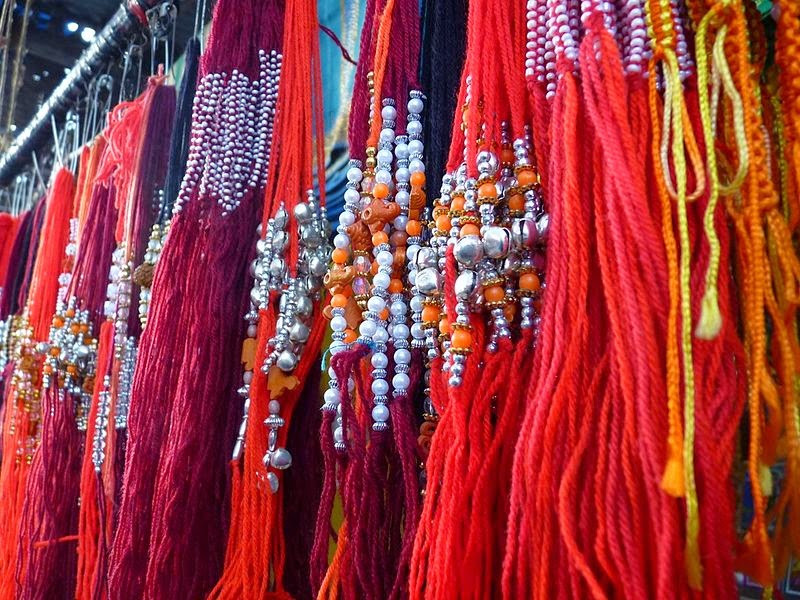
The chaste bond of love between a brother and a sister is one of the deepest and noblest of human emotions. 'Raksha Bandhan' or 'Rakhi' is a special occasion to celebrate this emotional bonding by tying a holy thread around the wrist. This thread, which pulsates with sisterly love and sublime sentiments, is rightly called the ‘Rakhi’. It means 'a bond of protection', and Raksha Bandhan signifies that the strong must protect the weak from all that’s evil.
The ritual is observed on the full moon day of the Hindi month of Shravan, on which sisters tie the sacred Rakhi string on their brothers' right wrists, and pray, for their long life. Rakhis are ideally made of silk with gold and silver threads, beautifully crafted embroidered sequins, and studded with semi precious stones.
The Social Binding
This ritual not only strengthens the bond of love between brothers and sisters, but also transcends the confines of the family. When a Rakhi is tied on the wrists of close friends and neighbors, it underscores the need for a harmonious social life, where every individual co-exist peacefully as brothers and sisters. All members of the community commit to protect each other and the society in such congregational Rakhi Utsavs, popularized by the Nobel laureate Bengali poet Rabindranath Tagore.
The Auspicious Full Moon
In Northern India, Rakhi Purnima is also called Kajri Purnima or Kajri Navami, when wheat or barley is sown, and goddess Bhagwati is worshipped. In Western states, the festival is called Nariyal Purnima or the Coconut Full Moon. In Southern India, Shravan Purnima is an important religious occasion, especially for the Brahmins. Raksha Bandhan is known by various names Vish Tarak - the destroyer of venom, Punya Pradayak - the bestowed of boons, and Pap Nashak- the destroyer of sins.
Rakhi in History
The strong bond represented by Rakhi has resulted in innumerable political ties among kingdoms and princely states. The pages of Indian history testify that the Rajput and Maratha queens have sent Rakhis even to Mughal kings who, despite their differences, have assuaged their Rakhi-sisters by offering help and protection at critical moments and honored the fraternal bond.
Rakhi Myths & Legends
According to one mythological allusion, Rakhi was intended to be the worship of the sea-god Varuna. Hence, offerings of coconut to Varuna, ceremonial bathing and fairs at waterfronts accompany this festival.
There are also myths that describe the ritual as observed by Indrani and Yamuna for their respective brothers Indra and Yama.
Once, Lord Indra stood almost vanquished in a long-drawn battle against the demons. Full of remorse, he sought the advice of Guru Brihaspati, who suggested for his sortie the auspicious day of Shravan Purnima (fullmoon day of the month of Shravan). On that day, Indra's wife and Brihaspati tied a sacred thread on the wrist of Indra, who then attacked the demon with renewed force and routed him.
Thus the Raksha Bhandhan symbolizes all aspects of protection of the good from evil forces. Even in the great epic Mahabharata, we find Krishna advising Yudhishtthir to tie the puissant Rakhi to guard himself against impending evils.
In the ancient Puranik scriptures, it is said that King Bali's stronghold had been the Raakhi. Hence while tying the rakhi this couplet is usually recited:
Yena baddho Balee raajaa daanavendro mahaabalah
tena twaam anubadhnaami rakshe maa chala maa chala
"We are tying a Rakhi on you, like the one on mighty demon king Bali. Be firm, O Rakhi, do not falter."
Why Rakhi?
Rituals like Rakhi, there is no doubt, help ease out various societal strains, induce fellow-feeling, open up channels of expression, and give us an opportunity to rework on our role as human beings and, most importantly, bring joy in our mundane lives.
“May all be happy, May all be free from ills, May all behold only the good and May none be in distress?” This has always been the idea of an ideal society.  
Please accept my hearty regards and congratulation of Happy Rakhi Bandhan May God bless you all bonus physical condition, prosperity, elevated position, command, authority, capability, prospect, assets, constancy to enhance promotion and propagation of peace and organization.
Hope always I will found you, that you  are great dreamer”; “remarkable ability”; “hard taskmaster”; “strict disciplinarian”; “amazing”; “realist”; “idealist”; “clarity of vision, sense of purpose, diligent perseverance”; “excellent organizational ability: “rich insight into human psychology”; “sheer strength of character and courage”.


We all humanity of the world and antiapartheid people condemn Israel's aggression


Gaza is passing through a most volatile situation, unprecedented atmosphere of confusion and chaos, loot and arson, hatred and bloodshed for last many times. The open dance of death and destruction is almost un-abated. The death of children and number of orphans is increasing manifold and the length of graveyards crossing boundaries with every passing day. The screams of helpless widows and orphans, are catching no attention of a noble and Godly heart. The land of prophets and Sufis, once an example of peace and communal harmony, mutual co-existence and tranquility, has now become the land of uncertainty, turmoil and bleeding hearts.
The helpless noble souls are shedding tears of blood and helplessness prevails over all noble minds. Some innocent children and people, as a matter of routine, are laying their lives in blasts or hand grenade attacks, others are sacrificing their lives in cross firings for no fault on their part.
Under these circumstances, why not world communities are endeavoring to bridge up the gap between individual-to-individual, community-to-community and region to region for a log period. The Gaza is also taking every step to re- establish the human values and eroded faith among the world communities. humanity should try to process of ensuring dialogue between whole countries of the world and People of the Gaza for lasting peace through non- violence propagated by the ideology of father of the Nation- Mahatma Gandhi and Practiced by Moulana Azad, Dr. Ram Manohar Lohia etc.
Today, when galaxy of intellectuals, thinkers, scholars and peace loving countries men not only from the less country but also from other more whole nation of the world have put their heads together yearning peace, hope the Gaza is approaching day and night, all the political parties, social and religious groups and all schools of thoughts all over the world with the appeal to rise above their levels in the larger interests of unity and integrity of the nation and support the peace.
So that we all humanity of the world and antiapartheid people condemn Israel's aggression to the people of Gaza and urge you and the masses of the worlds to take action to stop Israel's war crimes because this human catastrophe, genocide against non combatants’ civilians by a blatant military power.
Children are victims of this aggression of Israel; we all condemn Mr. Harper and Mr. Baird to take part from aggressor side in pretext of self to protect. Please do not take part the same action as Pharaohs did with Sons of Jacob (Peace on him) in Egypt to save and survive for their dynasty and reign.


Global Impact Factor


The Global Impact Factor (GIF) provides quantitative and qualitative tool for ranking, evaluating and categorizing the journals for academic evaluation and excellence. This factor is used for evaluating the prestige of journals. The evaluation is carried out by considering the factors like peer review originality, scientific quality, technical editing quality, editorial quality and regularity.
We perform the in-depth analysis method. The acceptance and rejection rates of journals can be a determining factor. Low acceptance rate, high rejection rate journals are considered the best and most prestigious journals as the acceptance criteria is of high quality standard. Many journals and societies have web pages that give publication data and style requirements and often include acceptance/rejection rates. The paper copy of the journal occasionally includes this data and will always provide current contact information.
Whether a journal is indexed in the major indexing/abstracting service in the field is another criteria that can be used to assess the worth and quality of a journal.
Inclusion in our database through which all journals can be registered, not just those deemed appropriate by an arbitrary group of individuals. However, it is important to note that we respects the various scientific communities submitting their information by allowing those communities to determine what they want to have displayed globally and what they want to keep confidential. Many countries may, for example, not want to have details about their scientists and projects listed.
Journals indexed in Global Impact Factor database will have the right to use the GIF logo and the Global Impact Factor value displayed on their website.
Dear Writers / Authors, You will be happy to see on-line publication of  a international e-journal in Urdu and English which is full academic and here giving link of the same We need research papers  for both kindly send your research paper for periodical in the same please also Suggest your colleagues, Friends, Professors for the same. Basic information about the Papers please visits our website
You will be pleased to distinguish that nowadays our journal Urdu Scholars Ki Duniya- International Refereed Journal achieved Impact Factor from Global Impact Factor Australia and is receiving well known popularity in the field of literary circles as well as in the media and in spite of this does need more preamble and exhibition around the world. 
We are contented to be acquainted with our International Journal Urdu Scholars Ki Duniya, ISSN2320-5369, acknowledged Global Impact Factor No. 2013 - 0.364.
It is great news for us our Journal Urdu Scholars Ki Duniya- International Refereed Journal for Urdu now Impact Factor from Global Impact Factor Australia


Friday, August 8, 2014

Five Rules to Remember in Life


1.      Forgive your enemy but remember the bastard's name.
2.      Money cannot buy happiness but it’s more comfortable to cry in a Mercedes than on a bicycle.
3.      Help someone when they are in trouble and they will remember you when they're in trouble again.
4.      Many people are alive only because it’s illegal to shoot them.

5.      Alcohol does not solve any problems, but then again, neither• does milk. These should assist you with most daily decision choices.